
Reviewed · SOUND OF MUSIC TOURS
Nuns and Nazis Walking Tour in Salzburg
Salzburg can feel like a postcard. Then this walk flips the postcard and shows you what happened here in WWII, plus how the Sound of Music legend grew from it. I love that Leo mixes Sound of Music filming spots with real, local WWII traces, and I like how personal the stories feel because his family history is tied to the period.
Two hours to two hours 15 minutes sounds manageable, but the emotional weight and the walking add up. The one drawback: you’ll want good patience for serious topics and you should plan for rain or chill days, since the tour can run a bit longer in practice.
In This Review
- Key things that make this tour worth your time
- Salzburg on the sunny surface, and the war beneath it
- Meet Leo: why one guide’s family story changes the tone
- Mirabell Gardens and the movie-start mood: when romance meets reality
- Makartplatz and the power of renaming places
- Linzergasse and the Stolpersteine: memorials you can’t step over
- Steingasse urban legend: trust your instincts, not the hype
- Staatsbrücke: the bridge built by prisoners and forced labor
- Alter Markt and a Jewish family story—escape, or not
- Grosses Festspielhaus and the Trapps performing in real life
- Residenzplatz and the Anschluss: Nazi takeover plus book burning
- Stift Nonnberg Abbey: nuns, views, and the Sound of Music finale
- Price and timing: does $20.64 feel fair?
- Who this tour is perfect for (and who should choose something else)
- Should you book the Nuns and Nazis tour?
- FAQ
- What is the duration of the Nuns and Nazis Walking Tour in Salzburg?
- How much does the tour cost?
- Where does the tour start, and what’s the ending point?
- What time does the tour begin?
- How many stops are included during the walk?
- Do you need to pay separate admission at the stops?
- Do I get a mobile ticket?
- Is the group size limited?
- Is the tour suitable for someone with only moderate mobility or fitness?
- Are service animals allowed?
- Can I cancel and get a full refund?
Key things that make this tour worth your time
- Leo’s personal angle: his family history shapes how he explains Salzburg’s WWII past.
- Sound of Music locations without the fluff: you’ll connect movie moments to real streets and buildings.
- Stolpersteine in Linzergasse: small memorial stones in the middle of everyday life.
- A working bridge story at Staatsbrücke: POWs and forced laborers helped build it.
- Nonnberg Abbey as the finale: nuns, big views, and the Sound of Music link all in one place.
Follow the do-re-mi trail a little further
- The Original Sound of Music Tour in Salzburg★ 4.5 · 6,129 reviews
- Salzburg: Original Sound of Music Tour★ 4.8 · 5,059 reviews
- Salzburg: Hallstatt and Sound of Music Tour★ 4.7 · 522 reviews
- Salzburg Super Saver: Original Sound of Music and Salt Mines Day Trip★ 4.5 · 345 reviews
Salzburg on the sunny surface, and the war beneath it
Salzburg sells serenity. The music, the stone lanes, the classic viewpoints—they’re all real. But the city also carries scars from the Nazi era, and this tour helps you notice them without turning your day into a textbook lesson.
What works best is the balance. You’re not just hearing horror stories. You’re walking a route where the city itself does the talking: what people built, what they renamed, what they stole, and what they tried to erase. Then you get the Sound of Music thread braided through it, especially the Trapp family and the movie’s legacy.
This isn’t a general-history tour, so if you already know the broad timeline, you’ll feel right at home. If you don’t, you may still enjoy it, but the tour is aimed at the specific Salzburg angle and the way the film shaped how people remember it.
Meet Leo: why one guide’s family story changes the tone
You meet in central Salzburg near Kurgarten (Rainerstraße 2). The tour runs with a small group size—up to 25 people—so you’re not stuck in a loud herd. You’ll also get a mobile ticket, so you’re not fumbling with paper.
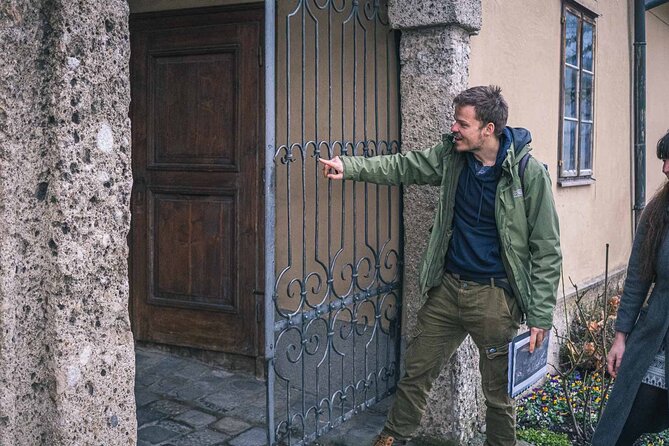
The biggest difference is the guide himself: Leo. The tour is built around the idea that Salzburg’s Nazi-era traces aren’t gone just because they’re quiet now. Leo’s family history is connected to that past, and you feel the care in how he frames things: not shock for shock’s sake, but context for what you’re seeing in front of you.
That personal layer matters because it changes how you read the city. Instead of just asking what happened, you’ll start noticing who lived here, who was targeted, and how the same streets could look normal on one day and deadly on another.
Mirabell Gardens and the movie-start mood: when romance meets reality
The walk begins near Schloss Mirabell and moves through the Mirabellgarten. This is a key Sound of Music connection, and it’s an important way to “set your eyes” for the rest of the day.
Here’s why I like starting this way: Mirabell gives you the familiar Salzburg look—green paths, classic buildings, and the kind of views that make visitors relax. Then, as the tour continues, you stop treating beauty as harmless background. The city becomes a stage where both joy and harm happened.
You’ll spend around 15 minutes in this area, with the main point being to connect the filming location feeling with what you’ll learn later—how the film made people see Salzburg a certain way, while the war left different marks in the same spaces.
Practical tip: if you’re a Sound of Music fan, it helps to refresh your memory before you go. The tour focuses on movie-era places, but many moments in the film are brief, so you’ll catch more when you recall what you saw.
Makartplatz and the power of renaming places
Next you head to Makartplatz, a square that changed names across the WWII era—before, during, and after. That detail might sound minor at first, but it’s actually one of the clearest ways history shows up in daily life.
When regimes rename public spaces, they’re not just making labels. They’re pushing identity onto the city. You’ll look at the surrounding buildings and learn how the war shaped what you see now, physically and emotionally.
The tour keeps this segment tight (about 10 minutes). You won’t get lost in lectures. Instead, you’ll get a quick way to interpret what you’re seeing: architecture and street corners as witnesses, not just scenery.
If you like history that you can walk through, this stop is a good hinge between the movie-sweet opening and the harder WWII chapters ahead.
The old town lanes on foot, a few more routes


Linzergasse and the Stolpersteine: memorials you can’t step over
In Linzergasse, Leo introduces Stolpersteine—small memorial stones laid for victims of the Nazi regime. This is one of those moments where the tour shifts from “stories about the past” to “the past in your path.”
Why it hits: these stones aren’t big monuments that force your attention. They’re placed where people walk and live. That means you’re meant to slow down and notice. It’s a simple idea, and it takes real effort to take it in.
This portion lasts around 10 minutes, but you’ll likely need those minutes to look closely and absorb what you’re reading. It also gives you a more humane way to understand WWII: not only battles and leaders, but individuals whose names are now literally embedded in the street.
Practical note: wear shoes that handle uneven sidewalks. This tour is mostly flat-town walking, but you still want sure footing when you’re stopping frequently to look.
Steingasse urban legend: trust your instincts, not the hype
At Steingasse, Leo shares an urban legend about a trace of WWII in Salzburg. The wording matters: you’re encouraged to judge for yourself whether it feels credible to you.
That approach is refreshing. It reminds you that not every story tied to the war is documented in the same way. Some legends grow because they explain a feeling, or because people want the city to have a secret “proof” of what happened.
You get about 10 minutes here, which is long enough to hear the story and short enough that you don’t feel trapped in uncertainty. This stop works best if you like to think, ask questions, and compare what you’ve just learned from more concrete traces.
I’d treat this as a pause in the factual flow—use it to sharpen your “history-reading” instincts, not to hunt for certainty.
Staatsbrücke: the bridge built by prisoners and forced labor
Now you move to Staatsbrücke, the main bridge in Salzburg’s old town. This stop centers on forced labor during WWII: hundreds of prisoners of war and forced laborers worked against their will on the construction of the bridge.
This is heavy material, but the location makes it real. Bridges are functional. They’re the kind of place you usually cross without thinking about the labor behind them. Here, that normal act becomes a reminder: progress built on suffering leaves an imprint.
Expect around 10 minutes. In that time, you’ll understand why this stop belongs on a Salzburg WWII route even if you’ve seen bridges in other cities. It’s not the style of bridge that matters. It’s the human cost hidden under everyday movement.
If you’ve ever visited a church or museum and felt distant from what happened, this stop can bring you closer because it’s still used. The bridge is still there. The story is still anchored to it.
Alter Markt and a Jewish family story—escape, or not
At Alter Markt (Old Market), the tour shifts to stories about common people, including a Jewish family and how they escaped—or didn’t escape—Salzburg before the Nazis took over.
This stop is about human choices under pressure. You’ll be asked, implicitly, to think about timing, access, and fear. Even without getting into every detail of a single case (the tour is limited in time), the lesson is clear: history isn’t only a big national takeover. It’s also small moments when the difference between safety and harm can be a few days—or even a few hours.
You’ll spend about 10 minutes here. That’s enough for a focused story, and it keeps the tour moving toward the next big film-and-regime crossroads.
Grosses Festspielhaus and the Trapps performing in real life
Next comes Grosses Festspielhaus, tied to Sound of Music at the end when the Trapp family is getting ready to flee Salzburg. The twist is that the family actually performed there.
This is the “Separation anxiety” stop for movie fans. You might know the scene as a dramatic farewell. Then you learn the family wasn’t only acting out a story on screen—the performances connected to a real venue in the real city.
You get about 15 minutes here. That extra time matters because this is where the tour’s two threads really merge: Nazi-era pressure on one side, and culture and performance on the other.
If you’re thinking, Wait, how does this fit with the darker parts?—that’s exactly the point. Salzburg’s culture didn’t disappear during the war. It changed, adapted, and carried stories forward in different ways.
Residenzplatz and the Anschluss: Nazi takeover plus book burning
At Residenzplatz, the old town’s main square, Leo connects a cluster of topics: the Anschluss (Nazi takeover of Austria), more about the Trapp family, and the fact that Salzburg experienced a book burning during WWII.
This is one of the most “political and symbolic” stops on the route. A square like this is a natural stage for public life—so it makes sense that it becomes a stage for public control too. You’re not only seeing buildings; you’re learning how power showed up in public space.
Time here is longer—around 20 minutes—because the stop carries more than one thread. It also helps you connect the early filming-location Salzburg to the wartime Salzburg you’ve been walking through.
If you’re someone who likes your facts tied to specific places, this is where your mental map really solidifies.
Stift Nonnberg Abbey: nuns, views, and the Sound of Music finale
The tour ends at Stift Nonnberg Abbey (Nonnberggasse 8). From Residenzplatz, you walk toward this lesser-visited but major sight, and you’ll get a view of the Alps along the way.
Nonnberg Abbey is described as the oldest women’s monastery in the world, and it’s also connected to Sound of Music. Leo saves this for the final moments because it’s where you feel both the spiritual “nuns” part of the title and the Salzburg-in-the-movie part of the day.
You spend about 20 minutes here, and the location is also practical for your next step: you can continue your walk along the footpath toward Hohensalzburg if your legs still want more.
What I like about ending here is the way it restores perspective. You don’t leave the war behind, but you gain a calmer setting. The Abbey gives you a different kind of history—one tied to women’s religious life over centuries, not only to one decade of Nazi rule.
Price and timing: does $20.64 feel fair?
At $20.64 per person, this tour sits in the “small cost, big payoff” category if you care about WWII specifics tied to real Salzburg corners. You’re not just buying a walk. You’re paying for a guide who can connect movie locations, Nazi-era traces, and family context into one route.
Duration is listed as about 2 to 2 hours 15 minutes, with at least one mention of longer stretches (around 3 hours). I’d plan around the listed time, but build in a little cushion—especially if it’s cold or rainy when you’ll be moving slowly and listening longer.
Value also comes from the format: a small group (max 25), a mobile ticket, and multiple stops that are each meaningful on their own. Every stop is designed to add a piece to the Salzburg puzzle—not to repeat the same talking points again and again.
Who this tour is perfect for (and who should choose something else)
This is a great fit if you:
- Love Sound of Music and want the city behind the movie, not just the famous scenes.
- Want WWII history anchored in street-level places: stones, bridges, squares, and buildings.
- Like a guide who brings personal stakes (Leo’s family history is part of the framing).
You might prefer another option if you:
- Want a purely general WWII overview. This walk focuses on Salzburg’s Second World War traces, not a full background lecture.
- Don’t handle heavy topics well. The tour includes forced labor and Nazi persecution themes, so it’s not a light afternoon stroll.
Should you book the Nuns and Nazis tour?
I think you should book if your goal is to understand Salzburg as a real place with layered memory. This tour is one of the few ways to walk the city and get both the Sound of Music magic and the WWII reality without switching cities or doing extra days of research.
Choose it if you like thoughtful stories, specific stops, and a route that makes you look down at the street level—especially at the Stolpersteine—and up at key landmarks like Nonnberg Abbey. If you want your Salzburg only sunny, skip it. If you want Salzburg that tells the whole truth, this one is worth your time.
FAQ
What is the duration of the Nuns and Nazis Walking Tour in Salzburg?
The tour lasts about 2 hours to 2 hours 15 minutes.
How much does the tour cost?
The price is $20.64 per person.
Where does the tour start, and what’s the ending point?
It starts near Kurgarten, Rainerstraße 2, 5020 Salzburg and ends at Nonnberg Abbey, Nonnberggasse 8, 5020 Salzburg.
What time does the tour begin?
The start time listed is 3:00 pm.
How many stops are included during the walk?
The experience includes nine named stops, ending at Stift Nonnberg Abbey.
Do you need to pay separate admission at the stops?
Admission tickets are listed as free for the stops.
Do I get a mobile ticket?
Yes, the tour uses a mobile ticket.
Is the group size limited?
Yes. The tour has a maximum of 25 travelers.
Is the tour suitable for someone with only moderate mobility or fitness?
It’s noted that travelers should have moderate physical fitness.
Are service animals allowed?
Yes. Service animals are allowed.
Can I cancel and get a full refund?
Yes. The policy allows free cancellation, and a full refund is available if you cancel at least 24 hours before the experience start time.
Salzburg and the Obersalzberg, in Full
- Salzburg: Dark History Tour
★ 4.3 · 171 reviews
The Old Town on Foot, Continued
- Salzburg 2.5-Hour Walking Tour: Mozart, Old Town & More
★ 4.2 · 987 reviews - Salzburg: Old Town, Mozart, & Mirabell Gardens Walking Tour
★ 4.8 · 461 reviews - Salzburg Oldtown: Sightseeing Walking Tour with Licensed Local Guide
★ 5.0 · 392 reviews - Salzburg Old Town Walking Tour, Mozart, Mirabell Gardens
★ 4.5 · 201 reviews - Salzburg Old Town Highlights Private Walking Tour
★ 4.5 · 78 reviews
The Sound of Music, a Few More Trails
- The Original Sound of Music Tour in Salzburg
★ 4.5 · 6,129 reviews - Salzburg: Original Sound of Music Tour
★ 4.8 · 5,059 reviews - Salzburg: Hallstatt and Sound of Music Tour
★ 4.7 · 522 reviews - Salzburg Super Saver: Original Sound of Music and Salt Mines Day Trip
★ 4.5 · 345 reviews - Original Sound of Music Private Tour Salzburg
★ 4.5 · 310 reviews
Fresh from Salzburg: Latest Reviews

Sound of Music Tours, compared.
 ★ 4.5The Original Sound of Music Tour in SalzburgFrom $906,129 reviews
 ★ 4.8Original Sound of Music TourFrom $885,059 reviews
 ★ 4.7Hallstatt and Sound of Music TourFrom $164522 reviews
 ★ 4.5Salzburg Super Saver: Original Sound of Music and Salt Mines Day TripFrom $168345 reviews
 ★ 4.5Original Sound of Music Private Tour SalzburgFrom $725310 reviews
 ★ 4.7Sound of Music and Salt Mines TourFrom $164299 reviews
 ★ 4.5Salzburg Super Saver: Hallstatt & Original Sound of Music TourFrom $169162 reviews
 ★ 4.1From Vienna: Sound of Movies Musical Tour to SalzburgFrom $151153 reviews
Browse the lists this tour appears in